Mastering Blackland Prairie Gardening in Texas
blackland prairie gardening, how to garden in Texas clay soil, raised beds vs in-ground North Texas, Collin County garden soil
Why Blackland Prairie Soil Defeats Most North Texas Vegetable Gardens — And What to Do About It
If you live in McKinney, Frisco, Allen, Prosper, Celina, Princeton, Fairview, Sherman, or Denison, you’re gardening on the same thing I am: Blackland Prairie clay. It’s the dark, sticky soil that built North Texas agriculture and still underpins Collin and Grayson County pastures and wheat fields. It’s also the reason so many backyard vegetable beds here fail, no matter how many bags of compost or topsoil get dumped into a tilled strip of lawn. This isn’t just “heavy soil.” It’s a specific clay with specific behavior — and it will beat an in-ground vegetable garden every single time. Let’s name what you’re actually dealing with, why it fights you so hard, and what actually works for blackland prairie gardening in North Texas.
What Is Blackland Prairie Soil?
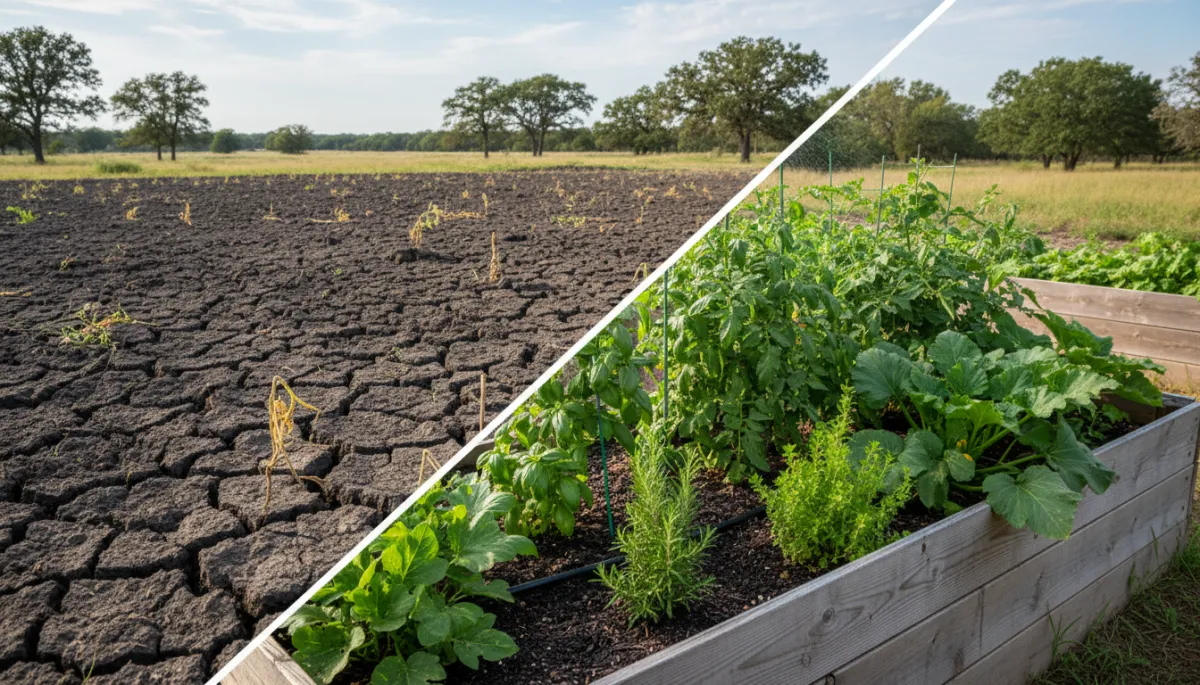
When people here talk about “that black gumbo,” they’re talking about a very specific soil: Blackland Prairie Vertisols — dark, heavy, smectite clay formed from ancient marine sediment. If you’ve ever tried to dig after a rain and felt like you were cutting into cold brownie batter, that’s it. When it’s dry, the same soil turns into hard, cracked plates that will stop a shovel dead. Those dramatic shifts are baked into its mineral structure, not a sign that you did anything wrong.
The “black” in Blackland comes from centuries of tallgrass prairie roots decomposing in place, building up organic matter and nutrients. That’s why this belt of soil running through North and Central Texas — including almost all of Collin County and a big slice of Grayson County — was famous for cotton, wheat, and sorghum. On a large field, with deep-rooted crops and heavy equipment, that fertility is an asset. On a 4×8 backyard vegetable plot, it’s a trap. You get the nutrients, but you also get the swelling, shrinking, and drainage headaches that come with smectite clay. For home-scale blackland prairie gardening, fertility is not the limiting factor — structure is.
Why Blackland Prairie Clay Defeats In-Ground Vegetable Gardens
After more than a decade growing food in Collin County garden soil, I see the same four failure patterns over and over in in-ground beds. None of them are fixed by “one more load of compost” or another pass with the tiller. They are baked into how this clay behaves in our weather.
1. Expansion and contraction that tears roots apart
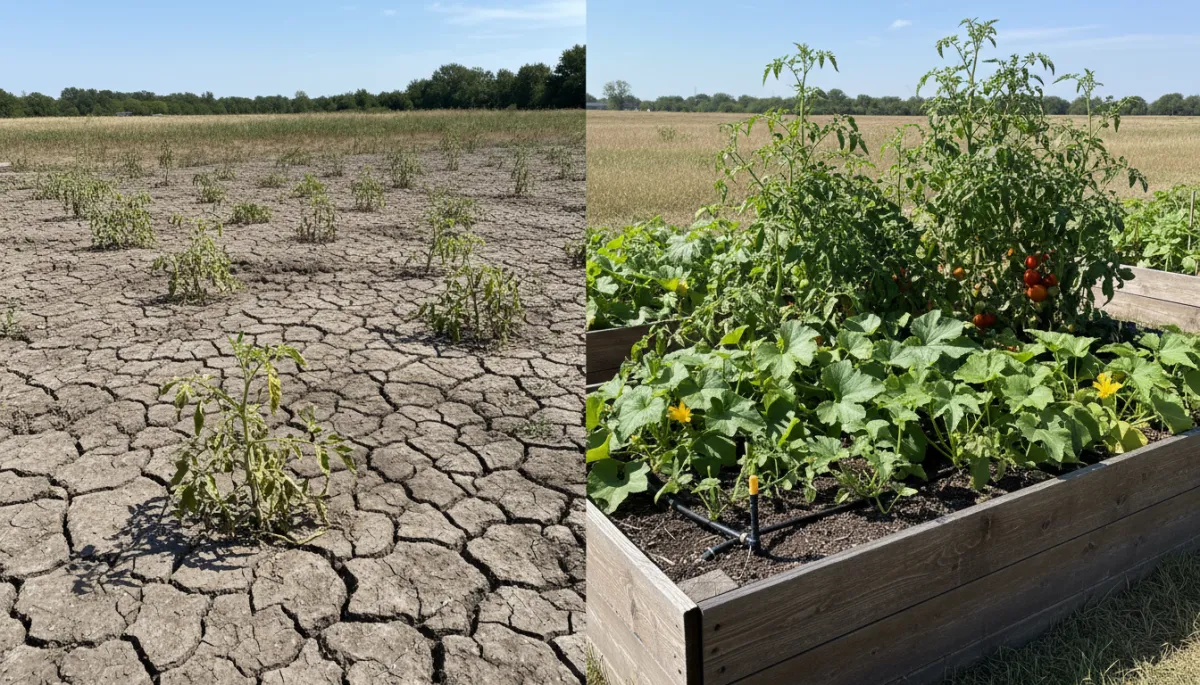
Smectite clay swells dramatically when it’s wet and shrinks hard when it dries. In a wet spring followed by a hot, windy June — a normal pattern in North Texas — that means your soil is constantly moving. In a vegetable bed tilled straight into native clay, tomato and pepper roots are literally riding a roller coaster. The soil grabs them when it swells, then pulls away and cracks when it shrinks. Root hairs shear off, fine feeder roots die back, and plants stall or collapse right when they should be taking off. You may blame heat or “bad plants,” but the real culprit is the soil heaving underneath them.
2. Drainage failure and chronic wet feet
Blackland Prairie clay holds water like a bathtub. After a thunderstorm, you’ll see puddles sitting for days in low spots in McKinney and Prosper yards. That same thing happens in an in-ground vegetable bed. Water either sits on top in a slick, or it slowly seeps down and pools in the root zone with nowhere to go. Most edible crops — especially tomatoes, peppers, squash, and herbs — need well-drained soil with air in it. In heavy Collin County garden soil, their roots suffocate, fungal diseases explode, and you end up with yellow, stunted plants in spite of “perfect” fertilizer numbers. This is a structural drainage problem, not a nutrient problem.
3. Compaction that turns worked soil back into concrete
I’ve watched so many North Texas gardeners rent a rototiller, fluff up that top 6–8 inches of clay, and feel like they’ve finally “fixed” their beds. By late summer, it’s back to brick. Once Blackland clay is worked, walked on, or driven over with a mower, it compacts to near-concrete density. The fine clay particles pack tightly, squeezing out pore space and oxygen. Roots hit that dense layer and stop. Water either perches above it or races off. You can fight it every spring with more tilling, but each pass breaks down structure further and accelerates compaction. In our region, bare in-ground veggie beds are on a one-way path back to hardpan.
4. Amendment limitations — why “just add compost” isn’t enough
You’ve probably heard the standard advice for how to garden in Texas clay soil: “Just add compost, and lots of it.” That’s not wrong — organic matter does help clay — but it is painfully incomplete for our Blackland. This clay is hungry. It absorbs and integrates organic matter deep into the profile. That’s great for long-term soil health on acreage, but in a home vegetable bed it means your spring’s worth of compost disappears into the clay matrix within a season or two. You don’t get a fluffy, loamy top layer that stays that way. You get slightly improved clay that still swells, shrinks, and compacts. You simply cannot amend your way to ideal North Texas vegetable garden soil in one spring, or even three, when you’re starting with true Blackland Prairie Vertisol.
Raised Beds vs. In-Ground on Blackland Prairie
Because of these structural issues, the real question in Collin and Grayson County isn’t whether you can grow vegetables in the ground — it’s how much time, money, and frustration you want to invest before you get consistent harvests. Here’s how in-ground beds compare to properly built raised beds on our native clay.
| Factor | In-Ground on Blackland Prairie | Raised Beds on Blackland Prairie |
|---|---|---|
| Drainage control | Poor; water pools or perches in dense clay | Excellent; gravity drains excess water through blended soil |
| Soil quality | Native Blackland clay with slow improvements over years | Custom-blended soil designed for vegetables and herbs |
| Workability | Compacts each season; hard to dig or weed after rains | Stays loose and friable year after year with light care |
| Root environment | Roots stressed by swelling, shrinking clay and low oxygen | Roots never touch native clay; stable, aerated root zone |
| Setup time to first harvest | Years of amendment and trial-and-error before consistent yields | Producing from day one with the right soil mix and irrigation |
| Irrigation efficiency | Water pools, runs off, or disappears into cracks unpredictably | Drip irrigation performs as designed with predictable moisture |
On our Blackland Prairie belt, raised beds aren’t a fancy upgrade — they’re the straightforward engineering answer to a soil that simply won’t behave like loam. Instead of fighting expansion, contraction, and compaction for years, you step above it and grow in a controlled environment from the first season. That’s the core of how to garden in Texas clay soil without losing your mind or your tomatoes.
How The Grower’s Life Designs for Blackland Prairie
At The Grower’s Life, every decision we make starts with a simple truth: you are not gardening in generic “Texas soil.” You’re gardening in Collin and Grayson County Blackland clay, and your system has to be built for it from the ground up — literally.
Beds that sit completely above native clay
Every TGL raised bed installation sits fully above the native soil profile. We’re not double-digging into your yard and mixing “a little compost” into that black gumbo. The wooden or metal frame creates a contained growing environment, and we fill it from the bottom up with a soil blend designed for vegetables. Plant roots stay in that engineered zone; they never have to fight the swelling, shrinking, or oxygen-poor conditions of the underlying clay. The Blackland becomes a stable base, not the medium your food is trying to grow in.
Custom soil blends for North Texas crops
We don’t dump in a random “garden mix” from the big box store and hope for the best. Your beds are filled with a custom-blended medium tuned for our heat, wind, and crop mix — usually a balance of screened topsoil, high-quality compost, and mineral ingredients that keep the structure open and well-drained. A tomato-heavy garden in Allen gets a slightly different balance than a greens-and-roots garden in Sherman. Because the soil is built right from day one, you’re starting where most in-ground North Texas vegetable gardens are still trying to get after five years of amendments.
Drip irrigation calibrated for raised beds, not pastures
Because Blackland Prairie drainage is so poor, most homeowners end up underwatering raised beds out of fear of “muddy soil.” We solve that by integrating drip irrigation into every installation and tying it into your outdoor hose bib. The system is designed for the soil in the bed, not the clay under your lawn. We size emitters, spacing, and run times so moisture moves evenly through the profile instead of pooling on top or vanishing into cracks. Once it’s dialed in, you get consistent moisture with far less waste than overhead sprinklers on native clay.
Placement and construction that respect soil movement
If you’ve seen sidewalks buckle or fence posts lean in Frisco or Celina, you’ve seen Blackland clay moving. We account for that same heaving and shifting when we place and build your beds. Frames are leveled and anchored with the understanding that the subsoil will swell and contract under them. Pathways are designed to shed water away from the beds instead of funneling it into them. The result is a system that rides out our wet springs and dry Augusts without twisting, sinking, or drowning your plants.
Designed by someone who has fought this clay for years
I’m Piper Klee-Waddle, Texas Master Gardener and owner of The Grower’s Life. I’ve grown food professionally in this exact soil for more than a decade — from market gardens in Collin County to backyard beds in Denison. I know what Blackland Prairie clay does in a wet March, a hailstorm in May, and a 108°F week in August, because I’ve watched crops live or die through all of it. Every installation we build is a distilled version of that experience, tailored to your yard, your sun, and your goals — and always grounded in the reality of our local soil.
This Is a Soil Problem, Not a Skill Problem
If your in-ground vegetable garden has failed in North Texas, odds are it wasn’t you. It was the Blackland Prairie under your feet. You were trying to coax shallow-rooted, drainage-sensitive crops out of a soil built for prairie grasses and row crops, not backyard tomatoes and basil. A raised bed system designed specifically for this clay — with the right soil blend, irrigation, and layout — fixes that from the very first season and keeps working year after year.
Ready to stop fighting your dirt and start harvesting? Explore how we build and maintain systems at thegrowerslife.com/raised-bed-gardens, then check whether we serve your address at thegrowerslife.com/zip-check. Blackland Prairie clay is tough, but it’s not a dead end. With the right design, your Collin or Grayson County backyard can be just as productive as the fields that made this soil famous — without the cracked hands, broken shovels, and disappointing harvests.
