Drip Irrigation for North Texas Raised Beds
Gardening, Drip Irrigation, North Texas Raised Beds
How Drip Irrigation Keeps a North Texas Raised Bed Garden Alive in August
August in North Texas is where gardens go to die — unless they have drip irrigation. Sustained temperatures over 100°F, low humidity, and brutal afternoon sun pull water out of raised beds faster than most homeowners can replace it with a hose. A raised bed without drip in August demands daily, careful attention and still loses plants to heat stress and wildly fluctuating soil moisture. A raised bed with drip irrigation on a timer quietly waters at dawn and keeps the soil consistently moist where it matters: at the roots. This post explains how drip irrigation works in a raised bed, why it is non‑negotiable in our North Texas summers, and what a properly set up system actually looks like in your yard.
Why North Texas Summer Breaks Hand-Watered Gardens
In Collin and Grayson County, a typical August afternoon gives you triple‑digit heat, wind, and humidity in the teens or low twenties. Raised beds are fantastic for drainage and root health, but that same design makes them dry out faster than in‑ground gardens. You have four exposed sides, more air movement, and a growing mix that is lighter and less dense than native soil. That is great for roots, terrible for moisture retention when the sun is punishing your garden from 2–7 p.m. every day.
In a full‑sun raised bed in McKinney, Frisco, or Sherman, you can easily lose 1–2 inches of soil moisture per week in July and August through evaporation and plant transpiration. That is not a theoretical number — it is what I see in production gardens when we track soil moisture probes. If you are hand watering, that means you are constantly playing catch‑up, trying to refill a reservoir that is draining all day long.
Hand watering is also inherently inconsistent. One evening you are tired and give the bed a quick once‑over. The next day you overcorrect and soak it. Vegetables hate that roller coaster. Inconsistent moisture leads directly to disease pressure, blossom drop, tough skins, and poor production. When a client in Allen says, “My tomatoes survive the heat but never set fruit,” I look at watering first, not temperature. Blossoms drop when the plant swings from too dry to too wet during fruit set — exactly what happens with irregular hose watering in a North Texas August.
Another local reality: our Blackland Prairie clay underneath your raised bed is not helping you. In loamy climates, moisture can move upward from deeper soil layers and buffer the plants between waterings. Here, the clay below your bed is dense, often dry, and acts more like a barrier than a sponge. Your raised bed is a self‑contained box. It lives or dies by the water you intentionally put into that mix. That is why raised bed irrigation in Collin County cannot be an afterthought — it is the life support system.
How Drip Irrigation Works in a Raised Bed
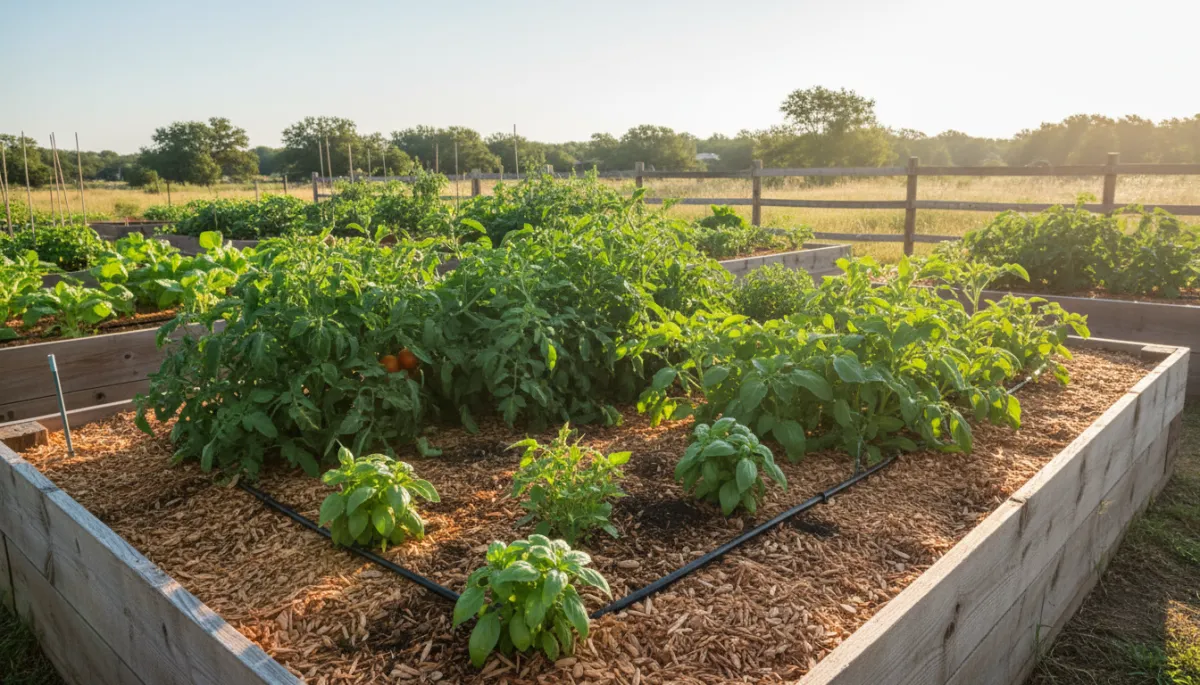
Drip irrigation is simple once you see it broken down. Water travels through a main supply line and then through smaller drip lines that run through your raised beds. Along those lines are emitters — tiny devices that release water at a controlled rate, usually between 0.5 and 2 gallons per hour. Instead of blasting water everywhere, drip applies a slow, steady trickle right at the soil surface where the roots are working.
For a homeowner in Prosper, Celina, or Fairview, the good news is that a drip system connects to a standard outdoor hose bib. No plumber, no trenching, no tapping into your in‑ground sprinkler system. We add a short assembly right at the faucet and run tubing from there to your beds. That assembly includes a timer, filter, and pressure regulator — the three pieces that turn a hose bib into a reliable raised bed irrigation system for North Texas conditions.
The timer is what makes the system feel like magic. You program it once, and it runs at the same time every day (or every other day) whether you are home, on a business trip, or hiding inside from the heat. For August, I prefer early morning — usually between 5:00 and 7:00 a.m. — so the plants start the day fully hydrated before the sun ramps up. That consistent schedule is the difference between plants surviving and plants producing through summer.
Because the water is delivered right to the soil surface at the root zone, you are not wasting water on leaves, pathways, or fence lines. Compared to overhead sprinklers, a well‑designed drip system can reduce evaporation and overspray losses by up to 50%. In our climate, that is not just about saving money on your water bill — it is about actually getting enough water into the root zone before it evaporates off the surface.
Many homeowners ask about soaker hose versus drip line. Soaker hose will work for a season or two, but the recycled rubber breaks down faster in our heat, kinks easily, and releases water unevenly — heavy at the start, weak at the far end. Drip line with individual, pressure‑compensating emitters is more durable, more precise, and easier to adjust for different plant needs. It is the standard in commercial kitchen gardens, and it is what The Grower’s Life installs in every raised bed.
What a Properly Set Up North Texas Drip System Looks Like
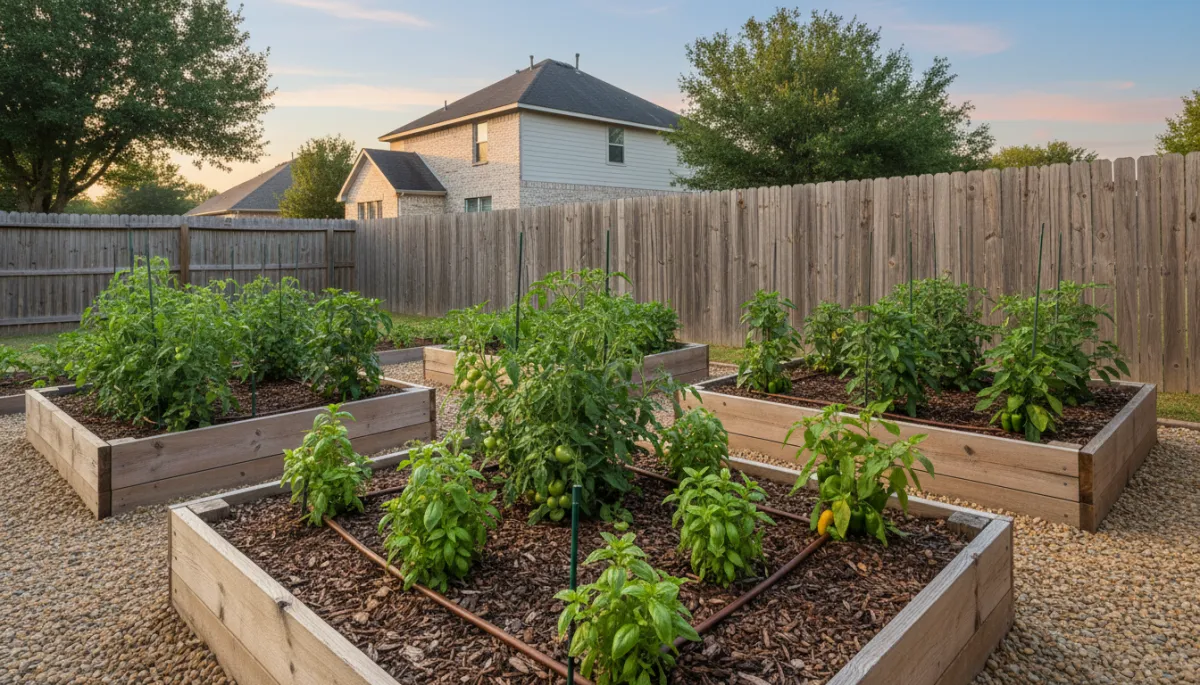
In a TGL installation, the drip layout is planned around your planting pattern, not the other way around. Drip lines run through each raised bed along the plant rows, with emitters positioned at each plant’s root zone — at the base of every tomato, at each pepper, along the carrot and beet rows at the right spacing. That means when the system runs, every plant is getting water where it can actually use it, not just “somewhere in the bed.”
The hose bib connection includes three critical components: a backflow preventer (to protect your home’s water supply), a filter, and a pressure regulator. The filter catches the fine grit and sediment that would otherwise clog emitters. The pressure regulator steps your city water pressure down to the gentle range drip systems are designed for. When DIY systems skip these, you see classic problems: emitters that quit on one end of the bed, lines that blow apart at fittings, and plants on the far side that never get enough water. We eliminate those failure points from day one.
At installation, I set the timer for your specific beds, soil mix, and plant list. In July and August, that usually means 20–30 minutes every morning for most vegetables, sometimes split into two shorter cycles for very exposed sites. In spring and fall, we dial that back. You are not guessing; you are starting with a schedule that has already kept raised bed gardens alive and productive through multiple North Texas summers in McKinney, Allen, and Denison backyards.
Finally, we cover the drip lines with a mulch layer — usually 2–3 inches of hardwood mulch or clean straw, depending on the bed. Mulch is not decorative in August; it is insulation. It shades the soil surface, reduces evaporation, and keeps root‑zone temperatures several degrees cooler. The combination of drip under mulch is what allows a raised bed to stay evenly moist when the air temperature is 105°F and the wind is pulling moisture off any exposed surface.
What Happens Without It — and What Drip Irrigation Saves You From
When I walk into a struggling, hand‑watered garden in August, I see the same patterns over and over. Tomato plants that look healthy but have almost no fruit — blossoms dropped during every hot, dry stretch because the soil swung from bone‑dry to flooded. Basil that wilted hard three or four afternoons in a row and finally stopped bouncing back, leaving woody stems and bitter leaves. Lettuce and other greens that bolted in April or May, weeks earlier than they should have, because the shallow roots dried out between inconsistent hose sessions.
Root crops tell the story too. Carrots and beets crack and split when they experience irregular wet‑dry cycles — dry soil that suddenly gets drenched, then dries again. You end up with misshapen, tough roots even if you planted the right varieties at the right time. That is not a seed problem; it is a watering pattern problem that drip irrigation solves by keeping the moisture level steady instead of swinging wildly.
The worst failure pattern is the “vacation collapse.” The garden looks decent heading into the second week of August. The family leaves town for five days, the neighbor waters once or twice, and the beds bake. By the time they get back, the tomatoes have dropped all new blossoms, the peppers are sun‑scalded, and the basil is a set of crispy flags. A properly programmed drip system would have watered every morning while they were gone, and the garden would have been ready to harvest instead of ready to rip out.
Why TGL Includes Drip Irrigation in Every Installation
For The Grower’s Life, drip irrigation is not an optional upgrade. Every raised bed installation we build in North Texas includes a complete drip system because a bed without it has a meaningful risk of failing in summer. I have managed irrigated kitchen gardens professionally through Collin County heat; I know exactly how fast an unirrigated bed can crash in August. I will not install a garden for a client that is set up to disappoint them four months later.
Setting the timer correctly is just as important as the hardware. At installation, I calibrate the schedule based on your bed size, soil mix, plant selection, sun exposure, and the current season. As conditions change, we adjust — and the North Texas Planting Calendar I provide includes guidance on seasonal irrigation timing alongside planting recommendations, so you are never guessing about how to water a raised bed garden in Texas summer again.
The connection itself is simple: a standard outdoor hose bib is all you need. No plumber, no permits, no new infrastructure. We design, install, and dial in the entire drip irrigation raised bed North Texas system the same day we build your garden, so it is ready to face August from day one.
Every TGL raised bed installation includes drip irrigation — designed, installed, and calibrated the same day your garden is built so it can thrive through our Collin and Grayson County summers. Visit our raised bed gardens page to see what this looks like in real backyards and schedule your install. And when you are ready to fine‑tune seasonal timing, the North Texas Planting Calendar walks you through irrigation adjustments alongside what to plant, month by month.
